

The Campaign Has Five Versions of the Truth

Updated: Jul 31
A cooking-class studio launches a seasonal workshop. The email says $95. The landing page says $110. A social post promises ingredients are included, while the booking confirmation tells guests to bring supplies. At the front desk, the printed reference sheet still carries last month’s start time.
No single asset looks disastrous. Together, they make the offer feel unreliable. The customer must decide which detail to trust before deciding whether to buy.
Conflicting Details Create Expensive Doubt
Campaign teams often treat this as a proofreading problem. It is usually a control problem. Prices, dates, eligibility, capacity, inclusions, proof, and calls to action are copied into multiple tools by different people at different times. A late change reaches four places and misses the fifth.
The resulting damage extends beyond a correction. Prospects pause. Staff improvise answers. Refund risk increases. Reporting becomes harder because customers responded to different versions of the offer. A campaign cannot teach a clear lesson when its live conditions kept changing.
Build One Campaign Control Card
Before production begins, create a short control card containing only the details every execution must inherit:
• intended audience
• offer and primary promise
• price and eligibility
• dates, availability, and capacity
• what is included or excluded
• approved proof
• primary call to action
• owner, approval date, and current version
This is not a second creative brief. The brief can hold context, tone, and ideas. The control card holds the live commercial facts that must remain identical wherever the campaign appears.
Give each field an owner. Finance may approve price. Operations may own capacity. The instructor may confirm inclusions. Marketing may own the promise and CTA. One campaign owner should approve the assembled record and resolve conflicts before anything ships.

Separate Strategy From Live Variables
Some decisions should remain stable throughout the campaign: the audience, customer problem, promise, proof standard, and desired action. Other details may change: available seats, dates, price, deadline, or delivery location.
Mark that distinction on the control card. Stable strategy should not drift because a channel needs fresh copy. Live variables should not be buried inside a paragraph that no one remembers to update. When capacity changes, the team should know exactly which field changed, who approved it, and which executions must be refreshed.
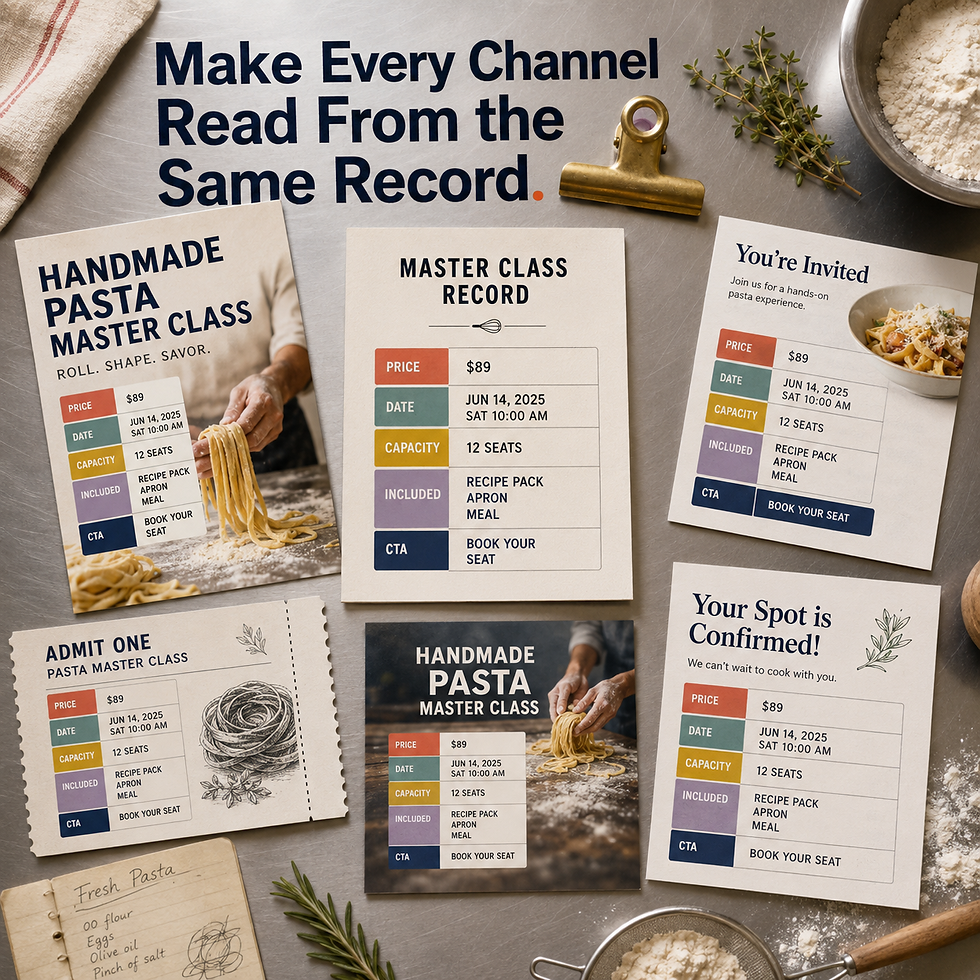
Make Every Channel Read From the Same Record
List every destination before launch: advertisement, landing page, email, social post, booking flow, confirmation message, printed material, staff script, and follow-up. Assign each destination an owner and a status: built, checked, live, or retired.
Then review facts across rows rather than reviewing assets one at a time. Check price everywhere. Then check date everywhere. Continue through inclusions, eligibility, proof, CTA, and response expectation. This reveals horizontal contradictions that a conventional asset review misses.
The same discipline applies to AI-assisted production. Generating ten variations faster only multiplies inconsistency when the approved facts are absent from the input. Automation should distribute a controlled record, not reconstruct the offer from old copy.
Change Once, Then Distribute
When a commercial detail changes, edit the control card first. Record the change, name the approver, and identify every affected destination. Do not begin by fixing the most visible page; that creates a temporary sixth version.
OrionPilot’s Strategy Interview and Strategy Summary can establish the audience, offer, proof, constraints, and growth priorities that the campaign control card should inherit. That baseline keeps rapid content production attached to the agreed commercial direction while the card manages the operational details that change during execution.
Audit the Edges
The most obvious campaign surfaces are rarely the only ones customers see. Search results may retain an old excerpt. Confirmation emails may use an earlier template. Reception staff may rely on a saved document. A partner may still have yesterday’s flyer.
Before launch, ask one person who did not build the campaign to attempt the booking and call with a practical question. After any major change, repeat the edge audit. Retire old materials instead of leaving them available “just in case.”
A campaign has one offer even when it has twenty executions. The work is ready when the customer, the booking system, and the person answering the phone all describe the same decision.


Comments