
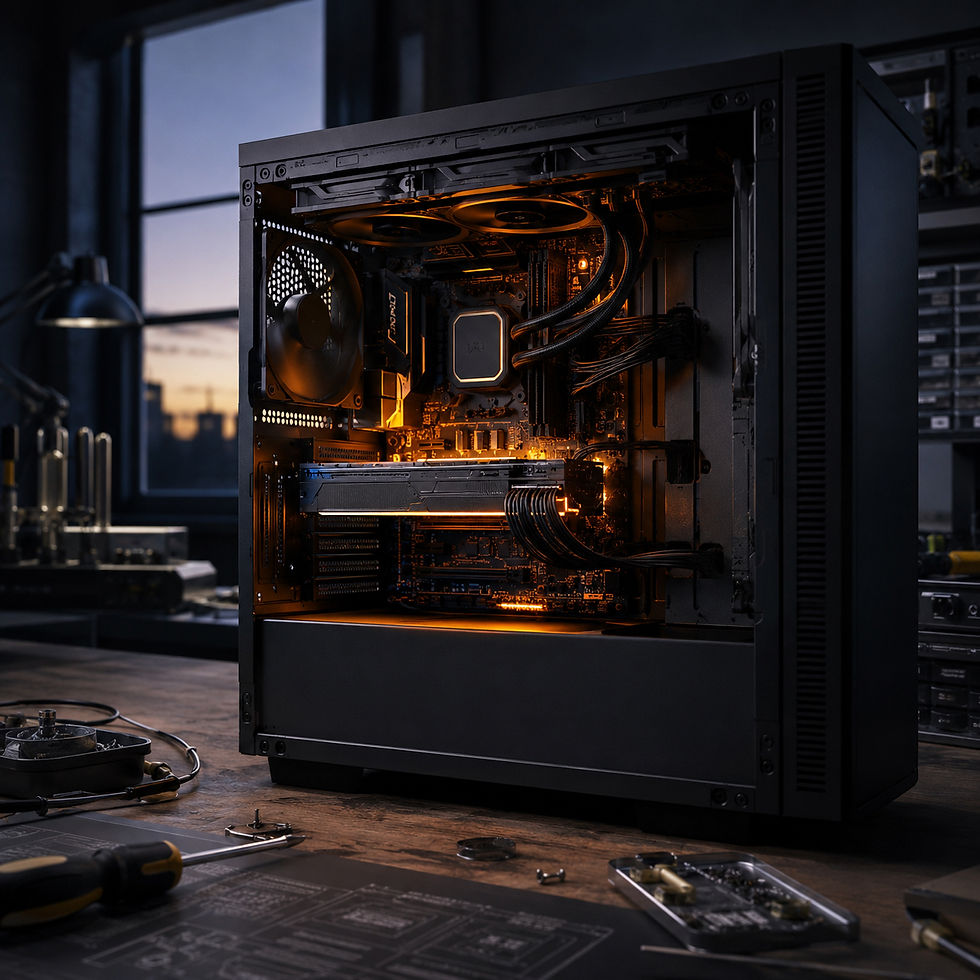
Meta’s Muse Glimmer Puts Agentic AI on a Single GPU.

On August 10, Meta released Muse Glimmer, an open-weight model built to perform agentic tasks on a Mac or PC equipped with a single graphics card. It is smaller than frontier systems, but that is the point: Glimmer brings useful reasoning and action onto hardware a business can own instead of renting every inference from a remote cloud.
Reuters reported that Meta plans to release weights for its more powerful Muse Spark 1.2 as well. Meta’s earlier Muse Spark 1.1 release framed the family around tool and computer use, coding, and multimodal understanding. Glimmer moves that program toward customer-owned hardware as companies question AI bills, data exposure, and dependence on a few providers.
For a small business or product team, the question is practical: what changes when an agent can live in the workstation under the desk?
Open-weight does not mean completely open
Model weights are the learned numerical parameters that shape how a neural network responds. When a company releases them, developers can download the model, run it on their own hardware, and often customize it for a task. That is fundamentally different from an API-only service, where the model stays on the provider’s servers and customers send requests across the network.
“Open-weight” is not automatically the same as open-source software. A release may provide the weights while withholding the training data, full training code, or unrestricted reuse rights. The license still decides whether the model can be modified, redistributed, or used commercially. Before a business adopts any downloadable model, the legal review should begin with the license—not the launch headline.
The distinction prevents a common mistake: assuming downloadable means transparent. Engineers can inspect, test, and alter more than with a closed API, but billions of parameters do not explain themselves. Openness expands control; it does not remove the need for evaluation.

One GPU changes the cost boundary
Cloud AI converts computing into a variable expense. Every request, token, image, or minute of processing can create another charge. That structure is useful when demand is uncertain or when a team needs the strongest model occasionally. It becomes less attractive for repetitive, high-volume work that does not require frontier intelligence.
A capable local model changes the calculation. After hardware, electricity, setup, and maintenance, the marginal cost of another classification, extraction, rewrite, or tool call can approach zero. Latency may fall because data no longer crosses the internet. Work can continue during a network outage. Sensitive documents can remain inside a controlled environment.
But “runs on one GPU” is not “runs for free.” The machine needs sufficient memory, cooling, power, and storage. Someone must manage updates, monitor failures, and decide when the model is no longer good enough. A cloud provider hides that burden; local AI moves it onto the owner’s balance sheet and staff.
Distillation compresses behavior, not every capability
Meta trained Glimmer through distillation, according to reporting on the release. In the original knowledge-distillation formulation, a smaller “student” model learns from the behavior of a larger “teacher.” The goal is to retain useful performance in a system that requires less computation.
The idea is closer to apprenticeship than file compression. The student observes patterns in the teacher’s responses and learns to reproduce them within a smaller architecture. It can become surprisingly capable on the behaviors emphasized during training while remaining weaker on obscure knowledge, long reasoning chains, or unfamiliar tasks.
That is why benchmark headlines are not enough. A company considering Glimmer—or any compact local model—should test the exact workflow it intends to automate: the real document formats, customer language, tool permissions, exception cases, and consequences of a wrong answer. A smaller model can be the better business system when its job is narrow, measurable, and frequent.

The best first jobs are bounded and repetitive
Local agents are especially attractive when the work contains private data and a clear definition of success. Examples include tagging a product catalog, extracting fields from invoices, classifying support messages, checking documents against a house style, generating metadata, routing internal requests, or preparing a first-pass summary for human review.
They are less suitable as unsupervised decision-makers in situations where an error can move money, deny service, publish a legal claim, or contact a customer with no recovery path. Running locally changes where the model operates; it does not make the model more accountable.
The useful design pattern is a narrow agent with limited tools, an explicit stop condition, and a human checkpoint at the moment consequences become material.
In OrionPilot, that could mean using a local model to organize campaign evidence or generate candidate variations while keeping final strategy, factual approval, and publication inside the visible weekly decision process.
Privacy improves only if the whole workflow stays local
A downloadable model can reduce data exposure, but the surrounding software matters. A local agent may still call cloud search, analytics, storage, email, or monitoring services. Logs may leave the machine. Plug-ins can transmit prompts. Updates can introduce new dependencies.
Security therefore has to be mapped at the workflow level. Teams should list every tool the agent can call, every destination that receives data, every credential it can access, and every action it can perform without approval. They should also verify the source of the weights, pin model versions, scan supporting packages, and preserve an audit trail.
There is a second tradeoff: a closed provider can patch a model centrally, while thousands of local copies can remain vulnerable or outdated. Ownership creates autonomy and maintenance debt at the same time.
Use a three-part decision test
Choose a local model when three conditions align.
First, the task repeats often enough that cloud usage cost or latency is material. Second, the data is sensitive enough that keeping it inside the business creates real value. Third, the task can be evaluated with examples and bounded so a failure does not silently spread.
If only the first condition is true, a cheaper hosted model may be simpler. If only privacy matters, a managed private deployment may reduce operational risk. If the work cannot be tested or bounded, bringing the model closer may merely bring the failure closer too.
Muse Glimmer matters because it puts a credible new option between a tiny on-device assistant and an expensive frontier API. The next AI contest will not be decided only by which lab builds the smartest model. It will also be decided by who can place enough intelligence inside the machines businesses already own—and make that intelligence reliable enough to trust with real work.


Comments