

The Product Demo, Directed Three Ways: Blendtec, Volvo Trucks, and Purple

Updated: Aug 16
Most businesses have at least one product claim a customer cannot inspect at first glance. A motor is “powerful.” A steering system is “precise.” A mattress is “pressure relieving.” Those adjectives may be accurate, but they still ask the buyer to supply belief.
The commercial problem is simple: when performance stays invisible, a weaker product with a clearer demonstration can be easier to choose.
Three famous demonstrations solve that problem in radically different ways. Blendtec destroys objects no kitchen blender was designed to meet.
Volvo Trucks turns steering precision into choreography. Purple places an egg between weight and a flexible grid. Each makes a technical property visible. Each also draws a boundary around what has actually been proved.
For an entrepreneur deciding how to show a product—not merely describe it—that boundary matters as much as the spectacle.

Destruction: Blendtec makes excess capacity visible
Blendtec’s “Will It Blend?” begins with a blunt question and ends with physical residue.
Founder Tom Dickson feeds golf balls, rake handles, phones, and other unlikely objects into a blender. The format came from a real engineering habit: Dickson pushed machines toward failure to find weaknesses. According to Blendtec’s account, a marketing director saw those tests in 2006, spent $50 on material for five videos, and the first batch collected six million YouTube views in six days.
The creative direction is almost anti-cinematic: a lab coat, a countertop, an object, a button, a result.
Repetition does the branding.
Viewers know the sequence before they know the victim. That predictability lets the object change while the claim stays fixed—this motor and jar can survive unreasonable work.
For a buyer, the demonstration compresses an abstract specification into debris.
Horsepower and blade design become a recognizable event. For a smaller company, this is the most accessible of the three models because the production does not need to look expensive. It needs a stable frame, a repeatable test, and an outcome that cannot be faked by adjectives.
The limit is equally clear.
Pulverizing a phone demonstrates excess power and mechanical endurance. It does not prove smoothie texture, noise, cleaning ease, or daily convenience. Spectacle can widen awareness while still answering only one purchase question. Blendtec succeeds because it does not pretend the test is a complete review.
Precision: Volvo turns engineering into choreography
Volvo Trucks faced the opposite problem. Volvo Dynamic Steering works through an electronically controlled electric motor attached to the steering shaft, supporting the hydraulic steering system.
The useful benefits—lighter low-speed control, filtering road irregularities, directional stability, and reliable self-centering while reversing—are difficult to dramatize with a diagram.
“The Epic Split” made one of those capabilities visible through distance.
Two Volvo FM trucks reverse in parallel. Jean-Claude Van Damme stands with one foot on each side mirror. As the trucks separate, his legs open into a split.
The spectacle is famous; the relevant evidence is quieter.
The drivers must first hold an exact gap and then widen it smoothly while moving backward. Volvo says that precision was enabled by Dynamic Steering.
The production treated proof as choreography rather than decoration.
The road, mirrors, bodies, camera, and steering system all had to agree. Remove the steering claim and the scene loses its reason to exist.
That is the standard many expensive demonstrations miss.
A large production can attract notice while the product remains interchangeable.
Volvo’s film avoids that trap because the dramatic action depends on the feature being sold. The image is memorable, but the engineering carries the plot.
Translation: Purple gives pressure a fragile proxy
A mattress presents a different creative obstacle: the promised experience is internal.
Support, softness, and pressure relief are felt over time, usually when the customer is no longer in a store.
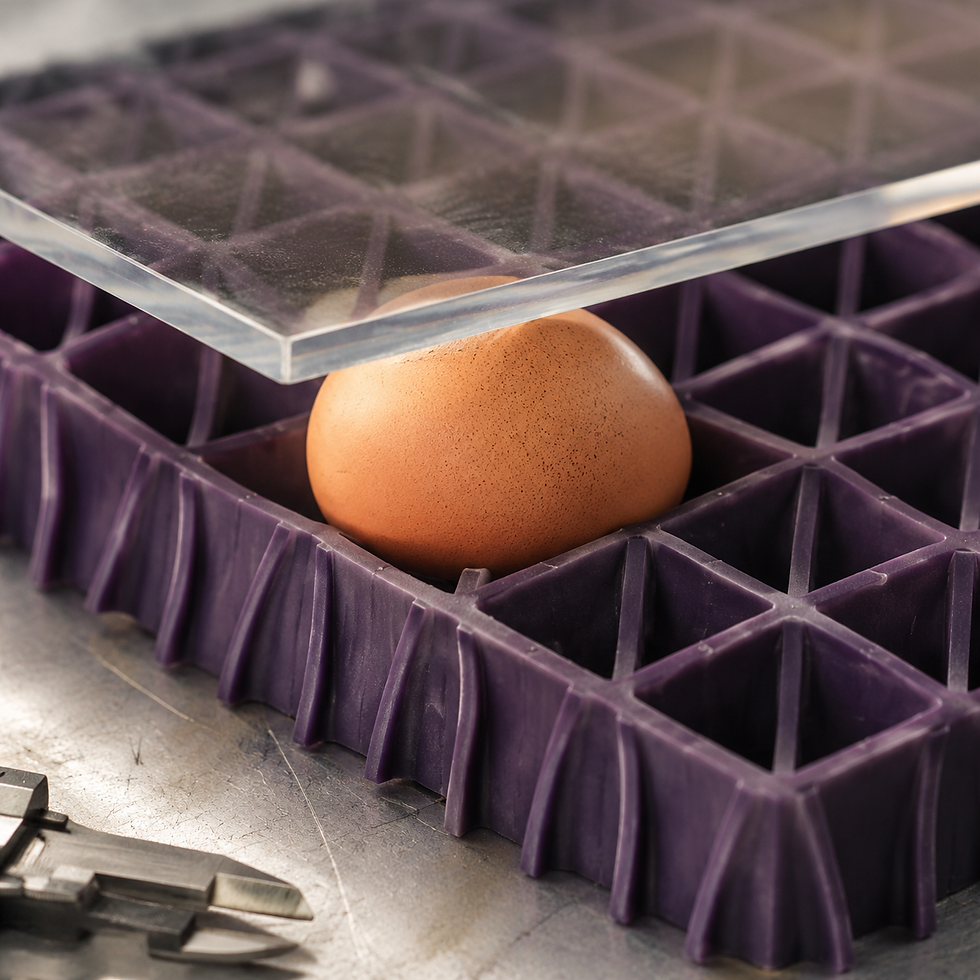
Purple’s Raw Egg Test translates that sensation into a fragile object anyone understands.
An uncooked egg rests on the company’s flexible grid beneath a sheet of glass or another load. The grid yields around the egg while supporting the surrounding weight. Purple describes the demonstration as evidence that its GelFlex Grid can be soft where the body needs pressure relief and firm where it needs support.
This is not a clinical trial, and it should not be read as one.
The egg is a proxy, not a sleeper. Its strength is communicative: viewers can see localized deformation and anticipate the consequence before the pressure arrives.
A technical material stops looking like a pattern of purple cells and starts behaving like an explanation.
The risk is analogy drift. If the audience remembers only that an egg did not crack, the demonstration becomes a party trick.
Purple continually reconnects the object to hips, shoulders, support, and the structure of the grid.
The creative task is not to find the strangest prop. It is to find the smallest physical event that clarifies the buyer’s hardest-to-imagine benefit.
Choose the proof before the production
These campaigns are often grouped as viral videos, but “viral” describes distribution after the fact.
Their more useful common feature appears before the camera rolls: each team chose a visible consequence for one invisible claim.
Blendtec uses excess.
Volvo uses precision. Purple uses translation.
Those are directing decisions, but they are also business decisions.
A demonstration should begin with the customer’s doubt, not with a demand for a dramatic video.
What does the buyer need to see change?
Which object, movement, comparison, or constraint would make that change difficult to dispute?
What remains unproved when the scene ends?
The last question protects the company from its own production.
A dramatic test can make one attribute dominate the brand, even when customers buy for a wider bundle of reasons. The strongest campaign therefore pairs its spectacle with the next layer of evidence: specifications, comparative testing, customer context, warranty terms, or a hands-on trial.
The demonstration opens the case; it should not impersonate the entire case.
For OrionPilot, that distinction is the planning value: content, channels, and measurement can be organized around the exact claim a demonstration makes, while downstream material answers what the hero scene deliberately leaves open.
Before approving a storyboard, remove the camera, celebrity, music, edit, and media budget. Write down the single physical change the audience will witness. If that sentence still contains only an adjective, the demonstration has not been designed yet.


Comments