
The Sample Drawer Is a Risk Register: How Independent Material Libraries Turn Specification Friction Into Repeat Business.

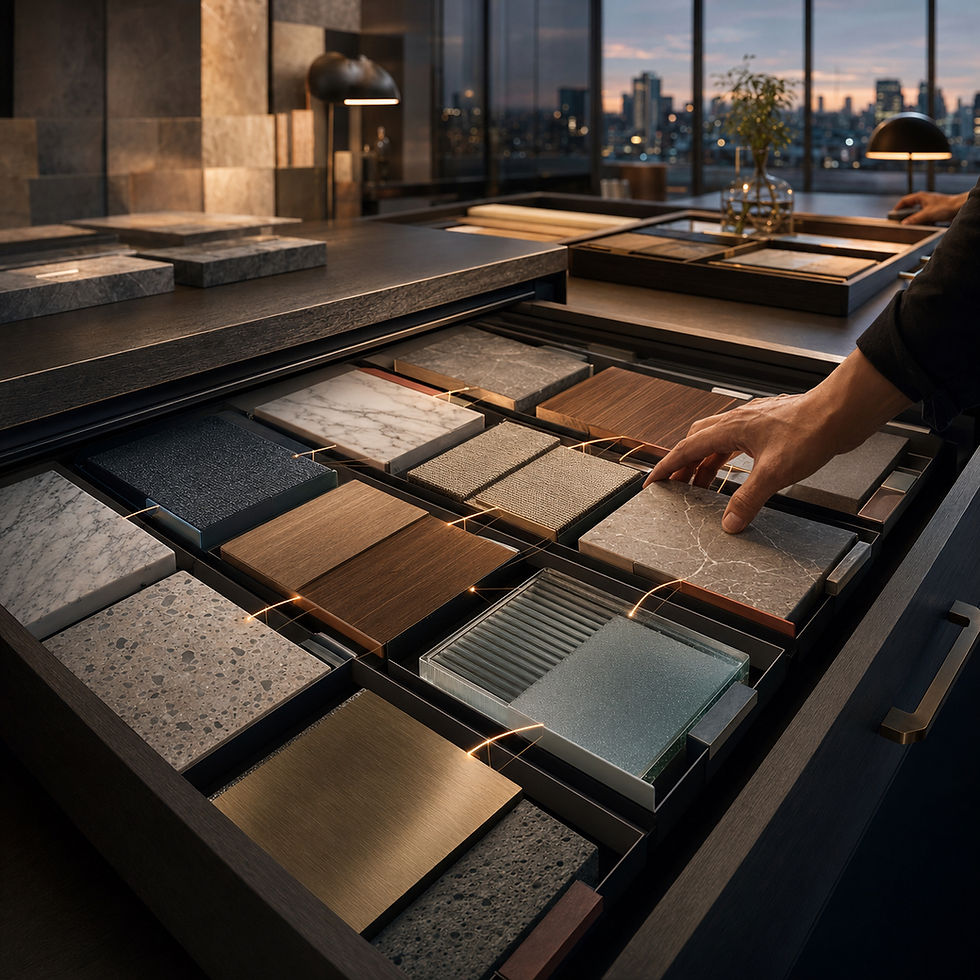
A sample library appears quiet: drawers of stone, walls of tile, binders of textile, metal chips, wood veneers, and glass arranged with almost museum-like precision. Yet every object in the room is under commercial pressure. A designer needs the right finish before a client meeting. A contractor needs confirmation that the selected material can arrive on schedule. A manufacturer changes a color, a thickness, or a lead time. A borrowed sample disappears into a project studio and returns months later—if it returns at all.
For an independent architectural-materials showroom, the product is not the sample. The product is confidence at the moment a specification becomes expensive.
The Sample Is a Promise About the Future
A swatch is small, but the decision attached to it may cover an entire hotel, restaurant, office, or residence. The buyer is not only asking whether the material looks right. They are asking whether it will perform, coordinate, install, age, clean, comply, and remain available when purchasing begins.
That makes every sample a promise about a future order. If the physical piece, digital record, price, lead time, and technical documentation disagree, the showroom creates risk precisely where it is supposed to remove it.
Strong operators therefore treat sample accuracy as a commercial discipline. Every active item needs a current source, collection name, finish, dimensions, application, installation limits, maintenance notes, availability status, and date of last verification.
Availability Is Not a Binary Answer
“Available” can mean several different things. The sample may be in the library but discontinued by the manufacturer. The product may still exist but require a minimum order. The finish may be available only in another thickness. The standard color may ship in two weeks while the custom version requires fourteen.
A better service vocabulary separates sample availability from product availability. The showroom can mark materials as current, conditionally available, special order, pending verification, or archived. This prevents a beautiful early presentation from becoming an embarrassing late-stage correction.
It also improves sales conversations. Instead of saying no after a client has committed emotionally, the showroom can present the constraint early and recommend the closest viable alternative.
Borrowing Must Produce Intelligence
Sample lending is often treated as a courtesy, but it can reveal the commercial pipeline. Who borrowed the material? For which project? At what stage? What alternatives were compared? When is the decision expected? Did the sample return because it lost, or because it was selected?
A disciplined lending process should be fast enough that designers will use it and structured enough that the business learns from it. A checkout can capture project type, expected specification date, quantity range, decision-maker, and return date without turning the interaction into paperwork.
The return creates a second opportunity. A short follow-up can identify whether the project advanced, stalled, changed direction, or requires a larger mock-up. The library becomes more than storage; it becomes a map of emerging demand.
The Most Valuable Service Is Translation
Manufacturers speak in collections, codes, test results, and production constraints. Designers think in atmosphere, proportion, light, touch, and narrative. Contractors think in tolerances, sequencing, installation, replacement, and schedule.
The independent showroom creates value by translating among those languages. It can explain why two visually similar materials behave differently, why a finish that works vertically may fail on a floor, or why a less dramatic option may protect the construction schedule.
This expertise should not remain hidden inside consultations. It can become useful marketing: comparison guides, installation warnings, material pairings, project-stage checklists, and short explanations of what changes cost or lead time. Educational content attracts better inquiries because it teaches clients how to specify with fewer expensive surprises.
Actionable Takeaways
Create one verification date for every active material record and remove items that cannot be confirmed.
Separate the status of the physical sample from the status of the product it represents.
Capture project stage and expected decision timing whenever a sample leaves the library.
Use returns and follow-ups to learn why materials were selected, rejected, or delayed.
Publish the knowledge that prevents specification mistakes, not only photographs of beautiful finishes.
Where OrionPilot Fits
OrionPilot can help a specialist showroom turn this operational knowledge into a clearer marketing system.
Its Strategy Interview can capture the audiences, manufacturers, specification stages, constraints, and growth priorities behind the business.
The resulting Strategy Summary and first-week plan can then organize practical work—such as clarifying service offers, creating educational content, and building customer communication around the risks the showroom is uniquely equipped to reduce.
The strongest material library is not the one with the fullest drawers. It is the one that makes a complex future decision feel dependable while the project can still change.


Comments