

The Shelf Is a Portfolio: How Artisan Marketplaces Can Use AI Without Turning Craft Into a Commodity.

Artisan marketplaces can use AI to understand shelf productivity, maker economics, and customer demand without flattening craft into interchangeable inventory.
A curated artisan marketplace looks abundant from the customer side. Shelves hold ceramics, textiles, candles, pantry goods, prints, and small-batch objects that feel personal rather than mass produced. Behind that experience is a difficult commercial equation. Every maker has a different lead time. Every product carries a different margin. Some pieces sell quickly but require constant replenishment. Others move slowly yet define the identity of the space. The retailer is not simply managing inventory. The retailer is managing a living portfolio of craft.
That distinction matters because conventional retail logic can easily damage the very thing customers came to find. If the marketplace optimizes only for speed, the safest items take over. If it gives every maker equal space, capital becomes trapped in products with very different economics. If the owner relies entirely on instinct, strong judgment can be overwhelmed by hundreds of small assortment decisions. AI can help, but only when it is used to make complexity visible—not to turn every object into an interchangeable unit.
The opportunity is to build a clearer decision system around the shelf. Which makers create repeat visits? Which categories deserve more space during specific seasons? Which products are profitable after handling, packaging, breakage, and replenishment time? Which slow sellers strengthen the brand enough to justify their place? The goal is not to automate taste. It is to give taste better commercial support.
The Assortment Problem Is Not a Sales Problem
A marketplace can know what sold last month and still misunderstand what is working.
A ceramic mug may sell steadily because it sits near the entrance.
A handmade jacket may sell less often but generate higher order value and longer customer conversations.
A fragrance line may appear modest in revenue while creating repeat visits from local customers.
Sales data records transactions. It does not automatically explain the role each product plays inside the market.
This is where AI can help owners compare patterns that are difficult to hold in one person’s head. It can group products by sell-through, gross margin, replenishment time, return frequency, handling needs, and attachment to other purchases.
It can surface combinations: customers who buy a candle may also buy a card; visitors drawn to ceramics may return for seasonal table linens; a maker with slower sales may still create strong traffic during demonstrations or launches.
The useful output is not a ranking of winners and losers. It is a more precise picture of contribution.
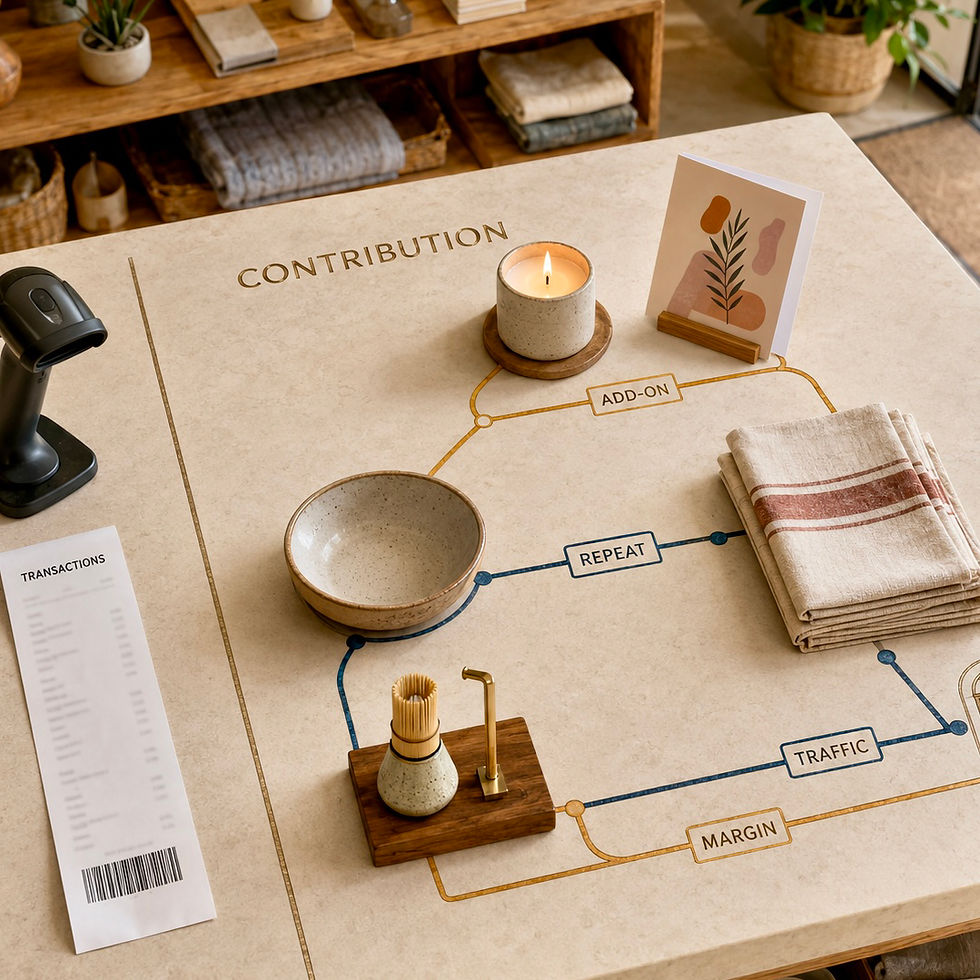
Revenue per Shelf Is Only the Beginning
Retailers often use space productivity because shelf space is finite. That is sensible, but artisan retail needs a broader calculation. A small object can produce excellent revenue per square foot while consuming disproportionate staff time, packaging materials, or replacement effort. A large statement piece may turn slowly but create visual authority for the entire store. A product with a low margin may still support a profitable bundle. The physical footprint is only one part of the economics.
A better model assigns several roles to the assortment.
Some products are reliable earners. Some introduce customers to the market at an accessible price.
Some create distinction.
Some support gifting.
Some generate seasonal urgency.
Some deepen a relationship with a maker whose future collections may become important.
AI can help classify these roles using historical data and owner-defined criteria. The owner still decides what the marketplace stands for; the model helps show whether the current shelf actually supports that intention.
AI Should Reveal Complexity, Not Erase It
The danger of optimization is false simplicity. A recommendation engine may suggest removing every slow-moving item, reducing the number of makers, and concentrating space around proven sellers. That might improve a short-term metric while making the store less memorable. Craft businesses are not valuable because every product behaves the same. They are valuable because the differences feel selected, human, and worth exploring.
The correct AI brief is therefore not, “Tell us what to cut.” It is, “Show us where commercial pressure and curatorial value are in conflict.”
That question creates a better conversation.
An owner might discover that a maker’s work deserves less permanent shelf space but a stronger quarterly feature.
A fragile product may need a higher price because breakage and packing time were never included.
A popular category may need fewer near-duplicates so the display feels edited rather than crowded.
AI becomes a lens for trade-offs, not an authority over taste.

The Customer Should Still Feel Discovery
Customers enter artisan markets because they want to find something they did not see everywhere else. That sense of discovery should remain visible even when the business becomes more analytical. The operational system can be precise behind the scenes while the retail experience stays generous, tactile, and surprising. The customer does not need to see a scoring model. The customer should feel that the right products are present, the selection changes with intention, and the staff understands why each maker belongs.
This has implications for merchandising. AI can identify categories that often sell together, but the final display should tell a story rather than resemble an automated recommendation feed. It can reveal that a certain price band is missing, but the owner should fill that gap with work that fits the market’s point of view. It can show that customers return when new collections arrive, but the launch should still feel like a cultural moment—not a stock rotation. Better intelligence should make the human curation more confident.
Build a Decision Rhythm Around the Market
The strongest use of AI is not a one-time assortment report. It is a recurring review that connects sales, margin, maker capacity, seasonal demand, and customer behavior. A monthly marketplace review might examine which products earned their space, which categories became overextended, which makers need a different placement, and which upcoming events require inventory changes. The structure gives the owner a repeatable way to make decisions without reacting to every slow week or sudden bestseller.
The review should also preserve context. A product may have been unavailable for two weeks. A maker may have delayed a shipment. A weather event may have reduced foot traffic. A store event may have temporarily lifted one category. AI can organize these variables, but the owner must add the real-world explanation. Over time, the marketplace develops a commercial memory: not merely what happened, but why a decision was made and what the business learned from it.
Actionable Takeaways
Start by assigning every product or maker a commercial role beyond “selling well” or “selling poorly.” Track gross margin, sell-through, replenishment time, handling effort, breakage or return risk, attachment to other purchases, and contribution to the store’s identity. Review those measures together rather than allowing one metric to decide the future of the shelf.
Use AI to identify patterns, exceptions, and trade-offs, then document the human decision that follows. Test changes in small increments: a new placement, a shorter feature, a revised price, a tighter collection, or a seasonal bundle. Measure the result without assuming the fastest-selling option is automatically the best. The marketplace should become more legible to the owner without becoming more predictable to the customer.
OrionPilot
OrionPilot helps businesses turn complex commercial realities into clearer strategy, stronger campaigns, and practical weekly decisions—while keeping human judgment at the center of what makes the brand worth choosing.


Comments