
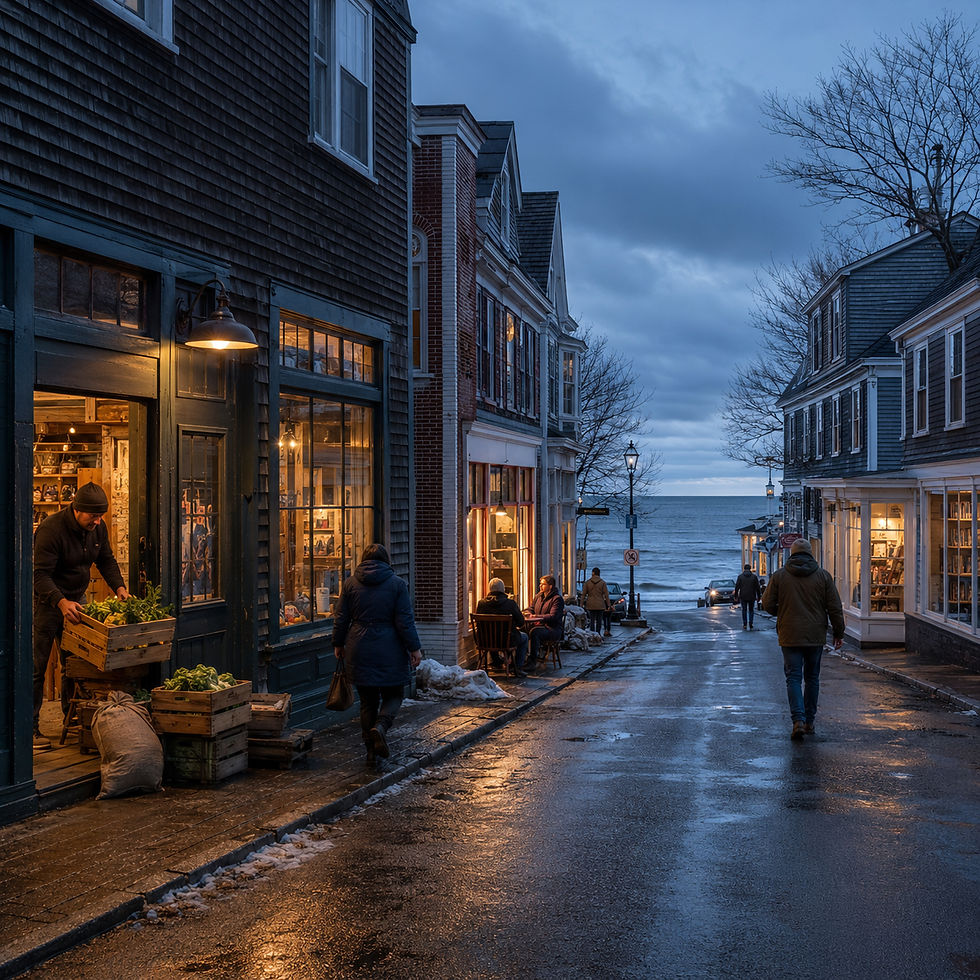
The Town After Summer: How Coastal Main Streets Build a Winter Economy Without Chasing Visitors Forever.

A coastal town in July can look like a complete economic success. Sidewalks are full, boats move in and out of the harbor, restaurant tables turn quickly, and every available room seems to carry a premium. The visible problem is usually capacity. The less visible problem arrives later, when the same streets empty, operating hours shrink, seasonal workers leave, and businesses that appeared strong discover how much of the year depends on a narrow window.
The goal should not be to make January imitate August. That usually produces discounting, generic events, and an exhausted version of the summer product. A more durable approach treats the off-season as a different economy with its own rhythm, customers, labor needs, and reasons to visit. Coastal communities become more resilient when they stop asking how to extend summer and start deciding what the town is worth after summer ends.
The Real Risk Is Economic Compression
Seasonality is not automatically a weakness. Scarcity can create urgency, protect premium pricing, and give a place its cultural rhythm. The danger appears when too much revenue, employment, and cash flow are compressed into a few weeks.
A busy season can disguise fragile fundamentals. Businesses may tolerate inefficient staffing because demand is high. Property owners may optimize every space for short-term visitors. Local suppliers may struggle to survive between peak periods. Residents can feel that the town performs for outsiders in summer and retreats from them in winter.
The response is not simply “more tourism.” It is a better distribution of economic activity. A healthy winter economy may be smaller than the summer economy, but it should be intentional enough to support core businesses, retain skilled people, and keep the town usable for those who live there.
Build a Calendar, Not a Longer Summer
Many destinations attempt to solve seasonality by adding isolated events. A food weekend, holiday market, or music festival can help, but a single spike rarely changes the operating logic of local businesses. The more useful question is whether the calendar creates a sequence of reasons to remain open.
That sequence might combine working-waterfront tours, winter food traditions, artist residencies, conservation programs, small conferences, school partnerships, coastal walks, and indoor cultural experiences. Each activity does not need to attract a crowd large enough for summer. Together, they can create dependable movement across several months.
The calendar should also respect local capacity. A winter program that requires summer staffing levels or expensive temporary infrastructure may reproduce the same vulnerability it is meant to solve. The strongest off-season concepts use assets the town already has: expertise, landscape, history, foodways, workshops, public rooms, and businesses with a reason to collaborate.

Give Businesses a Reason to Stay Open
Visitors cannot support a winter economy if the town appears closed. At the same time, independent businesses cannot remain open on optimism alone. The transition has to be coordinated.
A restaurant is more likely to extend its season when nearby lodging, galleries, transportation, and attractions are also operating. A shop benefits when local events are scheduled during useful retail hours rather than after the doors close. A small inn can sell a weekend more confidently when guests know what they will do after arrival.
Coordination does not require every business to keep identical hours. It requires a reliable promise. A rotating schedule, shared open-house weekend, or concentrated Thursday-to-Sunday operating pattern can be more credible than scattered availability. The town feels active because its open businesses reinforce one another instead of appearing as isolated exceptions.
Design for Residents Before Visitors
The best winter economies are useful to residents even when no one travels to see them. That principle changes investment priorities.
A year-round café, public market, rehearsal room, childcare option, repair service, fitness program, or community dining series may not look like a traditional tourism asset. Yet these services make it easier for people to live, work, and remain in the town. They also create the social texture visitors later find compelling.
When residents are treated only as seasonal labor or background atmosphere, the destination becomes increasingly artificial. When local life is supported, the place gains continuity. Visitors encounter a functioning community rather than a stage set waiting for peak season.
This does not mean every local service must become an attraction. It means destination development should strengthen the conditions that allow a real town to exist throughout the year.
Price the Shoulder Season Honestly
Off-season pricing often defaults to discounting. Lower rates can be appropriate, but price alone does not create a reason to travel. It can also communicate that the winter version of the destination is merely a lesser substitute.
A stronger offer prices the experience that actually exists. A quiet harbor, direct access to local makers, a chef-led dinner, a winter photography weekend, or a small-group coastal retreat may offer more intimacy than summer can provide. The value comes from access, atmosphere, and specificity rather than from trying to match peak-season volume.
Businesses should also account for the real cost of winter service. Heating, weather disruption, shorter daylight, limited staffing, and smaller purchasing volumes can make an apparently inexpensive booking costly to deliver. The right winter price protects the experience and the operator. It should feel deliberate, not apologetic.

Let Winter Reveal What Summer Hides
Summer rewards visibility. Winter rewards depth.
With fewer crowds, the details of a place become easier to notice: the working patterns of the harbor, the architecture of the main street, the relationship between weather and food, the knowledge held by craftspeople, and the rituals residents use to move through darker months. These are not backup attractions. They are part of the town’s identity.
Editorially, the shift is important. The winter story should not be “the same destination for less.” It should explain what becomes possible only when the pace changes. That may be quiet, access, learning, restoration, conversation, or participation.
A destination that can articulate this difference is less dependent on constant spectacle. It gives visitors a reason to choose the season rather than tolerate it.
Measure Resilience Differently
A summer economy is easy to celebrate because its numbers are visible: occupancy, foot traffic, covers, ticket sales, and marina activity. Winter resilience requires a broader view.
Useful questions include whether more businesses retain year-round staff, whether operating months are expanding, whether local suppliers receive steadier orders, whether residents have more services, and whether revenue is becoming less concentrated. A smaller number of better-distributed transactions may matter more than a single crowded weekend.
The purpose is not to eliminate seasonality. It is to prevent the entire business community from being governed by one short period. The town becomes stronger when summer remains valuable but no longer carries the full burden of survival.
Takeaways
Do not confuse a packed peak season with a resilient local economy.
Build a connected winter calendar instead of chasing isolated events.
Coordinate operating promises across businesses.
Invest in services that make the town livable for residents.
Price the off-season as a distinct experience, not a discounted imitation.
Measure success by continuity, retained capacity, and better-distributed revenue.
OrionPilot
OrionPilot helps independent businesses and local organizations turn scattered operating realities into clearer priorities, stronger offers, and practical plans for sustainable growth.


Comments